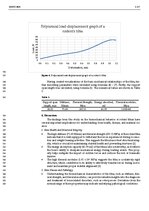
The rodent tibia plays a critical role in weight-bearing and force transfer during locomo-6 tion, making it an important subject of biomechanical study. This work aimed to analyze the three-7 point bending test data of rodent tibiae to gain a comprehensive understanding of their structural 8 integrity and load-bearing capacity. Tibiae from 20 male Wistar rats were subjected to three-point 9 bending tests using a material testing machine. The load-deformation and stress-strain data were 10 analyzed to calculate key biomechanical parameters, including stiffness, flexural strength, energy 11 absorbed, and flexural modulus. The rodent tibia exhibited the following biomechanical properties: 12 stiffness of 71.60 N/mm, flexural strength of 311.80 MPa, energy absorbed of 41.99 mJ, and flexural 13 modulus of 3.75 x 10⁵ MPa. These findings indicate the tibia has high structural integrity and load-14 bearing capacity, with robust stiffness, flexural strength, and energy dissipation capabilities. The 15 comprehensive analysis of the rodent tibia's biomechanical properties provides valuable insights 16 into bone health, disease, and material science. The high stiffness, flexural strength, and energy ab-17 sorption suggest the tibia is well-equipped to withstand the forces experienced during locomotion 18 and weight-bearing activities. These findings can inform preclinical research, guide the develop-19 ment of innovative biomaterials, and contribute to a deeper understanding of the skeletal system's 20 structure and function.…